

There’s a moment most gym-goers know well — you’re stuck in traffic at 6:15 AM, already twenty minutes late for leg day, watching the clock tick. Or it’s February, resolutions are evaporating everywhere, and the parking lot at your local fitness center looks like a mall on Black Friday. At some point, you start doing the math. What if that spare room, that half-empty garage, that forgotten corner of your basement became something genuinely useful? Home gym ideas don’t have to be expensive, complicated, or Instagram-perfect to work. They just have to work for you.
The truth is, more Americans than ever are investing in home fitness spaces. According to data from the American College of Sports Medicine, home exercise equipment sales surged dramatically during the early 2020s and never fully retreated. People realized that convenience, privacy, and the ability to train on your own schedule are worth a serious investment — even if that investment is just a single kettlebell and a foam mat.
This guide isn’t about showing you unattainable luxury gym transformations. It’s about real home gym design decisions — from equipment selection and room layout to lighting, flooring, and the psychological design cues that actually keep you motivated. Whether you have a two-car garage, a studio apartment, or something in between, there’s a setup here that fits your life.
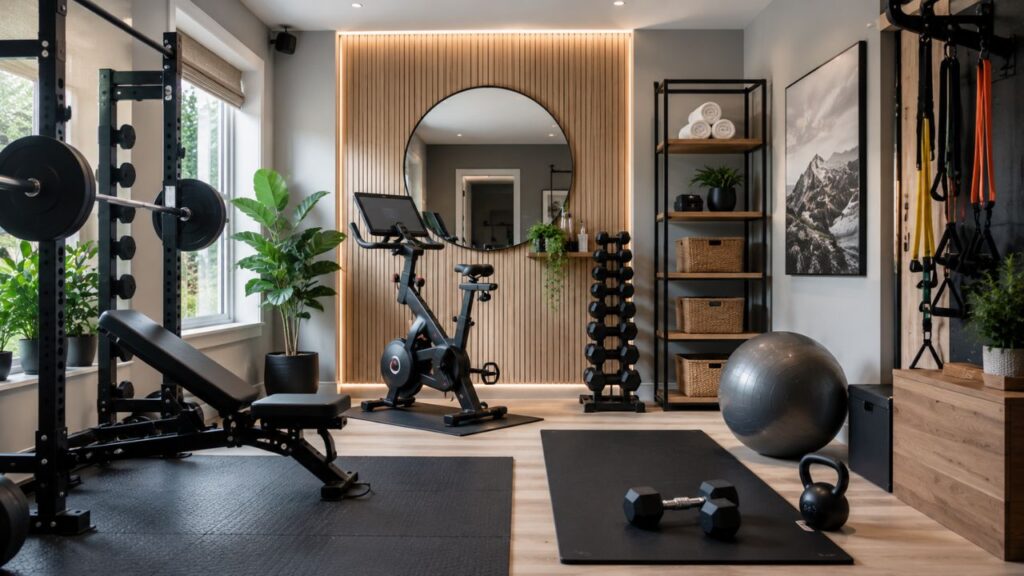
Why a Home Gym Pays Off More Than You Think
Before we talk about what to buy or how to build, it’s worth understanding why a dedicated workout space changes your behavior — not just your budget.
Fitness psychologists consistently note that environmental cues are among the strongest predictors of exercise adherence. When your gym is three steps from your kitchen, the activation energy required to start a workout drops significantly. You don’t pack a bag. You don’t commute. You just go. Over the course of a year, that friction reduction compounds into dozens of extra sessions.
There’s also the financial argument. A mid-range gym membership in the US averages around $50–$60 per month, according to industry data from Statista. Over five years, that’s $3,000–$3,600 — enough to build a genuinely capable home gym that you’ll own outright and never pay for again.
And then there’s the privacy factor, which more people cite than you might expect. No waiting for equipment, no unsolicited advice, no judgment during a rough workout. Your space, your rules.
Starting with Space: How to Assess What You’re Working With
One of the most common mistakes people make when planning home gym inspiration boards is that they start with equipment rather than space. Flip that order and you’ll save money, frustration, and wasted square footage.
Minimum Space Requirements by Equipment Type
As a rough starting point: a basic cardio-only setup (treadmill plus some open floor space) needs around 50–70 square feet. Add a power rack and barbell, and you’re looking at a minimum of 100 square feet to move safely. A full multi-station home gym with dedicated stretching, lifting, and cardio zones typically needs 150–200+ square feet.
Measure your space before you shop. Note ceiling height too — overhead pressing, pull-up bars, and some rowing machines require at least 8 feet of clearance. A ceiling that’s 7’4″ isn’t just awkward; it’s a safety concern with certain movements.
The Best Rooms for Home Gym Design
Garages are the most popular choice for good reason. They typically offer the most square footage, durable floors that can handle weight drops, and enough separation from living spaces that you can blast music without waking the house.
Basements come in a close second. They tend to stay cooler in summer, which matters more than people expect during intense training sessions. The main trade-offs are natural light (often minimal) and ceiling height (varies widely by construction era).
Spare bedrooms work well for lighter setups — yoga studios, Pilates spaces, resistance band stations, or a simple cardio-plus-free-weight corner. If you’re going this route, flooring protection becomes your first purchase, not your last.
Home Gym Flooring: The Foundation Nobody Talks About Enough
Ask any serious home gym owner what they wish they’d prioritized earlier, and flooring comes up constantly. It’s unglamorous, but it matters for safety, equipment longevity, noise reduction, and the overall feel of the space.
Rubber Flooring Options
Horse stall mats (typically 3/4″ thick, 4×6 feet, around $40–$50 each) are the gold standard for garage gym ideas. They’re dense enough to handle dropped weights, cheap enough to cover a full garage, and durable enough to last a decade with minimal maintenance. The main downside is a rubber smell that takes a few weeks to fully off-gas.
Interlocking foam tiles work better in carpeted rooms or spaces where you want more cushioning under bare feet — think yoga, stretching, or light dumbbell work. They won’t hold up as well under a loaded barbell, but they’re lightweight and rearrangeable.
For a finished aesthetic that suits a gym room ideas vision closer to a boutique studio, rubber-topped roll flooring in colors like slate grey or dark blue gives a clean, professional look without the commercial price tag.
Equipment Essentials: Building Your Setup Around Goals, Not Trends
Cool home gyms on social media are filled with equipment that looks impressive but rarely gets used. The most effective approach is to build around your actual training style rather than what the algorithm serves you.
Strength Training Foundations
A quality power rack (or squat stand for tighter spaces) combined with an Olympic barbell and 200–300 lbs of bumper plates covers squat, bench, deadlift, and overhead press variations — the foundation of most strength programs. Expect to invest $600–$1,500 for mid-range quality that will hold up for years.
Adjustable dumbbells are one of the smartest investments for small home gym ideas because they replace an entire rack of fixed weights. Brands like Bowflex SelectTech and PowerBlock offer up to 90 lbs per hand in a single compact unit. They’re pricier than a basic dumbbell pair, but the space savings are substantial.
Resistance bands get overlooked by people building their first setup, then end up being some of the most-used equipment in the room. They’re excellent for warm-ups, accessory work, rehabilitation exercises, and travel-ready training.
Cardio Without the Footprint
Full-size treadmills take up significant floor space and vibrate more than most people anticipate. If cardio is a priority but space isn’t generous, a rowing machine folds vertically for storage and delivers one of the highest calorie-burn-per-minute ratios of any cardio format. Concept2 remains the industry benchmark for a reason.
Assault bikes (fan bikes) and ski ergs are brutal in the best possible way and take up minimal footprint. They’re staples in functional fitness setups and worth serious consideration if you do any kind of interval training.
Half Garage Gym Ideas: Making the Most of a Shared Space
Not everyone wants to sacrifice an entire garage to fitness equipment. Half garage gym ideas have become increasingly practical as people find creative ways to share the space with a car, workshop, or storage area.
Smart Zoning Strategies
The key is a clean visual and physical boundary between the gym side and the utility side. Wall-mounted storage — pegboards for accessories, vertical plate trees, folding benches that tuck against walls — keeps the gym zone disciplined even when it’s compact.
Some homeowners use retractable rubber mats that roll up and store against one wall, allowing the concrete floor to serve double duty. Others install a pullup bar integrated into ceiling joists, which takes zero floor space and adds a high-value movement to the setup.
Lighting matters more in half-garage setups than in dedicated rooms. A targeted LED strip above the training zone signals to your brain that this area is different — a psychological cue that surprisingly makes workouts feel more intentional.
Home Gym Design: Lighting, Color, and the Psychology of Motivation
This is where most at home gym ideas fall short. People buy the equipment, lay the floor, and call it done. But the visual and sensory environment you train in has a measurable effect on performance and consistency.
Color Psychology in Gym Spaces
Research in environmental psychology suggests that bold, saturated colors — deep reds, vivid oranges, electric blues — can increase arousal and perceived energy levels. This is why commercial gyms rarely use beige or pale pastels.
For home gym inspiration that actually energizes, consider one accent wall in a high-saturation color while keeping the rest of the space neutral. Dark charcoal or matte black works particularly well for that industrial gym room feel without overwhelming a small space.
Lighting That Works for Training
Overhead fluorescent lights are common in garages and basements — functional, but harsh and unflattering. LED shop lights have improved dramatically and offer bright, even illumination at low cost. Position them to eliminate shadows in your lifting zone where proper form cues are visual.
If your gym gets natural light, protect it. A mirror positioned to reflect a window can double the perceived brightness and spaciousness of a room. Speaking of mirrors — full-length training mirrors aren’t vanity items. They’re legitimate form-checking tools, and a 4-panel mirror wall is one of the most cost-effective home gym design upgrades you can make.
Sound and Acoustics
Rubber flooring and padded walls don’t just protect surfaces — they absorb sound, which matters if you’re training in a shared living space. Adding a Bluetooth speaker at ear level (rather than across the room) gives you better sound quality at lower volumes. A dedicated training playlist, started at the same time each session, is one of the simplest behavioral cues for getting into a workout mindset quickly.
Small Home Gym Ideas for Apartments and Tight Spaces
Living in an apartment or a house with limited square footage doesn’t eliminate the possibility of an effective home setup — it just requires smarter choices.
Vertical Storage as a Design Strategy
Wall-mounted systems like Titan Fitness wall storage, DIY pegboards, or even standard garage shelving repurposed vertically can hold bands, jump ropes, sliders, kettlebells, and foam rollers without consuming any floor space. Treating your wall as storage infrastructure rather than decoration is one of the defining characteristics of well-executed small home gym ideas.
A foldable wall-mounted squat rack (often called a wall-fold rack) is a game-changer for small spaces. When folded flat, it protrudes only a few inches from the wall. Deployed, it handles full barbell work. Several US brands including Rogue Fitness and Rep Fitness offer well-reviewed options in the $300–$700 range.
Multipurpose Equipment Picks
For tight budgets and tight spaces, the best equipment is equipment that serves multiple functions. A set of kettlebells (one light, one medium, one heavy) handles strength, cardio, power, and mobility work. A TRX suspension trainer anchors to any door and delivers hundreds of movements. An adjustable bench folds flat for storage and unlocks chest, shoulder, and core variations that floor work can’t replicate.
Home gym inspo for smaller spaces is increasingly turning toward minimalist setups — a clean, curated collection of versatile tools rather than a crowded room trying to mimic a commercial gym. Less really is more when space is the constraint.
Home Gym Renovation Ideas: Upgrading an Existing Space
If you already have a basic setup and want to level it up, targeted home gym renovation ideas can dramatically improve both function and feel without a full rebuild.
Upgrades That Deliver the Most Value
Mirrors, as noted, transform a space visually and functionally. But if you’ve been training with basic lighting, upgrading to programmable LED panels with adjustable color temperature is a close second. Cooler light (5000K+) during training can improve alertness; warmer tones work for cool-down stretching.
Cable machines and functional trainers used to be the line between home gyms and commercial gyms. That gap has narrowed considerably. Compact cable towers from brands like Inspire Fitness or Rep Fitness now retail in the $800–$1,400 range and fit in a 4×4-foot footprint. If you’ve maxed out free weight work, a cable attachment adds exercise variety that keeps training fresh for years.
Wall decals, sports photography prints, and personal record (PR) boards give a gym personality without structural changes. A simple whiteboard where you track PRs is inexpensive, motivating, and adds a coaching-gym feel to even a bare concrete room.
Frequently Asked Questions
How much does it cost to build a basic home gym?
A functional starter setup — rubber flooring, adjustable dumbbells, a pull-up bar, and resistance bands — can be assembled for $300–$600. A more complete setup with a barbell, rack, plates, and cardio equipment typically runs $1,500–$3,500, depending on brand choices and whether you shop used equipment markets.
What’s the minimum space needed for a home gym?
You can get a solid workout in as little as 50 square feet if you focus on bodyweight training, resistance bands, and compact equipment. For a barbell-based strength setup, plan for at least 100 square feet of clear space, with higher ceilings preferred.
Is a garage or spare room better for a home gym?
Garages win for heavy lifting and equipment volume because of durability, square footage, and ventilation flexibility. Spare rooms are better suited for lighter setups, yoga, or Pilates where a finished, comfortable environment matters more than raw capacity.
What flooring is best for a home gym?
Horse stall mats are the most cost-effective choice for heavy lifting. Interlocking foam tiles suit lighter training and finished rooms. For aesthetics in a dedicated gym room, rubber roll flooring in matte colors offers a clean, professional look.
How do I keep a small home gym organized?
Vertical wall storage is your best tool. Wall-mounted brackets, pegboards, and vertical plate storage keep the floor clear. Designate specific spots for every item and return things after each session — gym organization habits follow the same principles as kitchen organization.
Do I need mirrors in a home gym?
They’re not strictly necessary, but they’re one of the highest-value additions you can make. Full-length mirrors help you check form on squats, deadlifts, and pressing movements without a spotter or camera. They also make smaller spaces feel significantly larger.
What equipment should I buy first for a home gym?
Start with what serves your primary training goal. For strength, a barbell and plates with a basic rack is the core investment. For general fitness, adjustable dumbbells plus a pull-up bar covers the most ground. Cardio equipment can come later once the strength foundation is in place.
Can I build a home gym on a budget?
Absolutely. Facebook Marketplace, Craigslist, and used sporting goods stores are full of quality equipment at 40–70% off retail. Post-holiday and post-January gym-resolution sales cycles are particularly good times to find barely-used equipment from people who didn’t follow through on fitness goals.
Final Thoughts
Building a home gym is one of the few investments that genuinely compounds over time — financially, physically, and in terms of the consistency it enables. The best home gym ideas aren’t the ones with the most equipment or the highest budget. They’re the ones designed thoughtfully around how you actually move, what you actually need, and the space you realistically have.
Start with the floor. Get the lighting right early. Choose equipment that matches your training style rather than what looks impressive on a shelf. And give the space some personality — a gym you enjoy being in is a gym you’ll actually use.
Your future self is going to be grateful you made this decision. Now go measure that garage.