

I still remember the first staircase I ever painted. It was a cramped back stairway leading up from a gloomy kitchen, covered in scuffed brown carpet that had seen better decades. Pulling that carpet back felt like unearthing buried treasure – solid oak treads just waiting for a second act. After a weekend of sanding, priming, and a lot of knee pain, those steps were reborn in a deep slate blue. That single change transformed the entire floor of the house, and I’ve been a little obsessed with painted stairs ever since.
If your staircase feels tired, dated, or just plain boring, paint might be the fastest, most affordable transformation you can make. It’s not about slapping on leftover wall emulsion and hoping for the best. The right approach – from choosing the best paint to prepping properly – makes the difference between a finish that lasts a decade and one that chips the first time the dog bolts upstairs. In this guide, I’ll walk you through everything: real-world painted stairs ideas, how to pick paint for stairs that can take a beating, and the exact steps for a flawless result. Whether you’re craving a colorful staircase or a crisp modern painted stairs look, there’s a path here for you.
Why a Painted Staircase Works So Hard
A staircase is the spine of a home. It gets more foot traffic than almost any other surface, yet we often treat it like an afterthought. A carefully painted staircase does more than look pretty – it can disguise worn treads, brighten a windowless hallway, and even make narrow stairs feel wider. Best of all, it costs a fraction of a new runner or replacement balustrade. If you’ve been scrolling painting stairs ideas online, you already know the rabbit hole goes deep. But the payoff is real: a well-executed stair painting project adds personality and can bump up your home’s perceived value, often in a single weekend.
I’ve seen a staircase painted in soft greige anchor an entire open-plan living area, and a flamboyant colorful stairs design turn a cookie-cutter spec house into a one-of-a-kind home. The trick is matching the look to your everyday life. Pets, kids, and work boots don’t care about high-concept design, so the materials and finish have to be as tough as they are beautiful.
Choosing the Right Paint for Stairs (Because Not Any Can Will Do)
Before you daydream about colour swatches, let’s talk chemistry. Standard wall paint is a disaster on floors. It lacks the abrasion resistance and adhesion needed for high-traffic surfaces. When I first attempted painting stairs, I used leftover satinwood meant for trim – within a month, the edges were bald and the risers looked shabby. Lesson learned. Dedicated stair paint exists for a reason.
Paint Types That Actually Hold Up
- Floor & porch enamel: Designed for foot traffic, it cures to a hard, scuff-resistant film. Look for brands like Benjamin Moore’s Floor & Patio or Sherwin-Williams’ Porch & Floor Enamel. These are ideal for painted stair treads because they handle grit and moisture.
- Acrylic-alkyd hybrids: Products like Dulux Diamond Hard or Valspar Cabinet & Furniture Paint give you the durability of an oil-based paint with water clean-up. They level beautifully and resist chipping, making them a top pick when I’m painting stair treads on a client’s project.
- Chalk paint with a topcoat: If you’re chasing a matte, vintage look, chalk paint by Annie Sloan can be used, but it must be sealed with a hard-wearing lacquer or several coats of polyurethane. Otherwise, you’ll be touching up every month.
- Two-pack epoxy kits: For concrete or metal stairs, a self-levelling epoxy system is the ultimate hard-wearing choice. It’s less common inside a home, but for a basement or industrial-style painted stair cases idea, it’s unbeatable.
Primer Is Not Optional
A high-adhesion primer, such as Zinsser B-I-N or Kilz Adhesion, prevents tannin bleed from wood and gives the topcoat something to grip. Skipping primer is the quickest way to peel city. I once tried to paint stairs without priming a glossy handrail – the paint literally slid off in sheets. So, don’t be that person. This is the best way to paint stairs if you want the job to last.
How to Paint Stairs: The Full Prep-to-Finish Guide
Understanding the sequence saves time and frustration. Here’s how I approach painting the stairs after painting twenty or so staircases over the years. Whether you’re working on a painted staircase ideas uk townhouse or a suburban split-level, the physics are the same.
Step 1: Clear and Clean
Remove rugs, gripper rods, staples, and loose debris. Vacuum every crevice. Wash treads and risers with a degreasing solution (I like Krud Kutter) because years of hand oils and wax buildup will repel paint. If you’ve wondered how to paint stairs that have been carpeted since the 1970s, heavy-duty cleaning is your first answer.
Step 2: Sand Until You’re Bored, Then Sand Some More
Sanding isn’t about creating dust art; it’s about keying the surface. Use 120-grit paper on an orbital sander for flat treads, and a sanding sponge for profiles and spindles. Don’t aim for bare wood – just knock off the gloss and smooth any chips. When painting stair treads, pay extra attention to the nose edge, where wear and tear hits hardest. A slightly rounded profile there helps paint cling.
Step 3: Fill, Caulk, and Tape
Wood filler for dents, caulk for gaps where risers meet treads, and painter’s tape along stringers and walls. Crisp lines are what separate a professional painted staircase from a sloppy one. Good prep is the best way to paint stairs without losing your mind later.
Step 4: Prime With Intention
Stain-blocking primer on raw wood, tannin-rich oak, or previously stained surfaces. Apply one thin, even coat and let it dry fully. Tack cloth between coats to remove any nibs. This step is crucial before painting the stairs topcoat.
Step 5: Paint the Hard-to-Reach Areas First
If you’re also tackling railings and spindles, start there. It’s easier to mask off treads from drips than the reverse. Use a mini roller for broad spindles and a high-quality angled brush for details. I work top-down, so I’m not leaning over wet paint.
Step 6: Tread and Riser Technique
When you’re ready to paint stairs themselves, begin at the top and work your way down, unless you have a second exit – then start at the bottom to avoid stranding yourself. I usually paint every other tread so the family can still skip-hop to bed. Apply thin coats; thick coats take forever to dry and dent easily. For painted stair treads, two coats of floor enamel plus a third on the nose will give you solid durability. Recoat time varies, but overnight drying between coats is safe.
Step 7: Cure Completely
Floor paint may feel dry in hours, but full cure takes up to seven days. Avoid heavy shoes, dragging furniture, and enthusiastic dogs until then. Trust me, I’ve learned this the hard way.
Painted Stairs Ideas to Suit Every Home
This is where the fun begins. The internet is full of painted stairs ideas, but I’ve pulled together concepts that actually work in real homes – not just Pinterest. Whether you’re renovating a Victorian terrace and hunting for painted staircase ideas uk inspiration, or modernising a 1990s split-level, there’s a look here.
Classic and Timeless Styles
- Tone-on-tone neutrals: Using the same colour in different sheens – matte risers, gloss treads – adds depth without chaos. A warm grey painted staircase like Farrow & Ball’s Elephant’s Breath on risers and a deeper Mole’s Breath on treads looks effortlessly elegant.
- White risers, dark treads: The contrast tricks the eye into seeing a wider tread. It’s a favourite in painted staircase ideas uk renovations, especially paired with original balusters.
- Wood stain and painted combos: If your treads are in good shape, strip and varnish them while painting the risers and stringers. This is one of my favourite painting stairs ideas because it marries warmth with modern crispness.
Bold, Colourful Stairs That Steal the Show
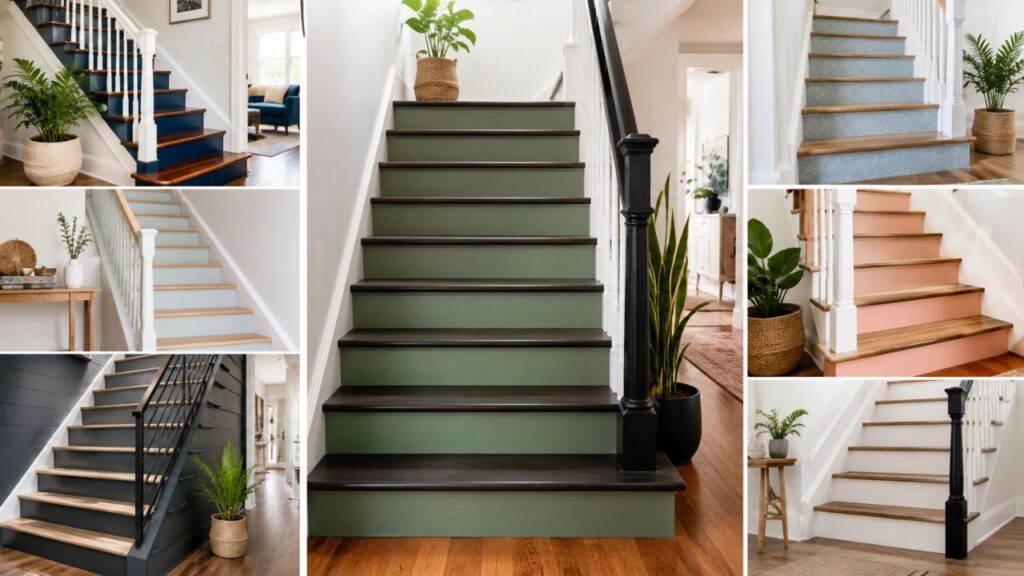
If you want a real statement, a colorful stairs design delivers drama. I’ve seen a rainbow gradient on risers that climbed from soft pink to vibrant tangerine – surprisingly chic. Another client chose a colorful staircase where each tread was a different shade of teal, anchored by white risers and walls. For a less intense approach, paint just the riser face in alternating colours, leaving treads natural or black.
Modern Painted Stairs for a Clean, Minimal Look
Modern painted stairs often feature monotone schemes – all black treads, risers, and handrail – for a sleek, gallery-like feel. Charcoal or jet black make a powerful anchor in a white-walled space. To keep it from feeling heavy, extend the same colour to the stair wall using stairs wall design painting. A matte finish hides imperfections and adds softness. The result is a staircase painted to feel like sculpture.
Painted Stair Treads with a Twist
If you’re nervous about full commitment, focus on the treads alone. Paint just the top surface, leaving the risers white or natural. Or create a runner effect by painting a central stripe down each tread, mimicking a carpet runner without the dust trap. This is a playful take on stair paint design that you can change whenever the mood strikes.
What Colour to Paint Stair Railing and Spindles
The railing is the handshake of the staircase – it’s what you touch every day. A lot of people get stuck on what color to paint stair railing, and it’s a valid question. If your treads are dark, a light or metallic handrail creates floating contrast. If the whole staircase is neutral, black iron-style paint on spindles and handrail injects definition. When you’re pondering what color to paint stair railing, consider the sight lines from other rooms. A railing painted the same colour as the surrounding trim ties the space together neatly. In a home with a lot of original woodwork, painting just the spindles while leaving the handrail stained is a beautiful compromise.
Don’t forget the balusters themselves. I recently used Rust-Oleum Universal Metallic in oil-rubbed bronze on a dated oak balustrade, and it instantly looked like expensive wrought iron. Small details like this are what make a painted stair cases project feel high-end.
Staircase Wall Painting: Walls That Work With Your Steps
The surface flanking your stairs is prime real estate for creativity. Stairs wall design painting can elongate a narrow hallway, frame a gallery wall, or simply banish the beige. When thinking about stairs wall painting, treat the vertical expanse as a single canvas. A continuous colour that flows from the ground floor up to the landing unifies the journey.
One of my favourite treatments is a two-tone wall with a dado-height shift: a deep, moody blue below the chair rail and a warm white above. This staircase wall stair wall colour interplay makes the climb feel intentional. For maximum impact, extend a bold colour from the risers right up the wall with unique wall painting for stairs – think geometric blocks or a softly blended ombré. These stairs wall painting techniques don’t require professional muralists; a good tape measure and a laser level work wonders.
Another unique wall painting for stairs idea is to paint a large-scale pattern, like oversized polka dots or a tonal diamond trellis, that leads the eye upward. If you’re tackling a full stairs wall design painting project, use eggshell or satin finish so it can be wiped clean – stair walls get surprisingly dirty from traffic and hand touches.
Ideas for Painting Stairs and Landing Together
The landing often gets forgotten, but it’s the pause point. Coordinating ideas for painting stairs and landing makes the whole circulation feel purposeful. Try running the same riser colour up the stairs and then painting the landing floor in a matching shade – just ensure you use slip-resistant floor paint. If you’re exploring ideas for painting stairs and landing in an open-plan setting, continuing the stair tread colour onto the landing as a “rug” of paint defines the zone without furniture.
More Painted Staircase Ideas UK Homes Will Love
If you’re updating a period property, there’s a wealth of painted staircase ideas uk homeowners can pull from. Soft sage risers against natural jute runners feel very Cotswolds cottage; high-gloss black with a brass stair rod channels a London townhouse. In more modern UK new-builds, I’ve seen painted staircase ideas uk that use pastel pink risers with a charcoal runner – gentle but not childish. Scrolling painting stairs ideas from British renovation accounts often reveals clever tricks, like painting only the riser returns (the tiny vertical lip) to catch light.
Caring for Your Painted Stairs
Once you’ve poured all that effort into your new painted staircase, protecting it keeps the “wow” alive. A sacrificial coat of clear matte polyurethane on treads can extend the life of painted stair treads by years. Avoid wet-mopping for the first month; instead, a barely damp microfiber flat mop handles dust. Place felt pads under furniture that might come near the bottom step, and train your indoor cat to keep claws off – easier said than done. If chips do happen, the beauty of stair paint is that touch-ups are quick. Keep a small jar of your custom colour and a fine artist’s brush handy for emergency fixes.
FAQ
How long does a painted staircase last before needing a refresh?
With proper prep and the right paint for stairs, you can get 5–8 years before wear spots appear on tread edges. High-traffic family staircases might need a light recoat on treads after 3 years. Compared to carpet replacement, it’s still a bargain.
Can I paint my stairs without sanding them first?
You can use a deglosser in place of sanding, but I rarely recommend skipping abrasion entirely. Liquid deglossers work for oil-based paints on previously painted surfaces, but raw wood or high-gloss varnish really needs mechanical sanding for proper adhesion. When in doubt, sand. It’s the best way to paint stairs that will stick for the long haul.
What is the most durable paint for stair treads?
A high-quality alkyd enamel floor paint, such as Benjamin Moore Floor & Patio or Dulux Diamond Hard Floor Paint, consistently outperforms standard trim paint. These products are formulated specifically for painting stair treads and resist scuffing, water, and household chemicals.
Should stair risers be painted white or a colour?
White risers reflect light and make a staircase feel airier, but they show scuff marks easily and need regular cleaning. If you’re after a low-maintenance staircase colour ideas scheme, choose a medium tone on risers that hides shoe scuffs. For a colorful stairs look, don’t be afraid to paint each riser a different jewel tone.
Is it better to use a brush, roller, or sprayer for painting stairs?
A high-density foam mini roller gives the smoothest finish on treads and risers; use a high-quality angled brush for cutting in edges and painting spindles. An HVLP sprayer is the fastest method for a full painted staircase but requires thorough masking and a well-ventilated space. I find the brush-and-roller combo works best for most DIY stair painting projects.
What’s the best way to paint stairs while still living in the house?
Paint every other tread first, so you have a temporary path. Once those are completely dry and cured, cover them with rosin paper and paint the remaining treads. This crawl-like-a-crab method saves marriages. It’s the most practical answer to how to paint stairs without moving out for a week.
Can I use the same paint for my stair wall and the stairs themselves?
No. Stair walls can take standard interior wall paint (eggshell or satin), but actual stair treads need floor-grade paint. That said, you can unify the colour visually by matching the hue – many stairs wall painting colour schemes borrow the exact shade from the risers for a seamless staircase wall stair wall colour transition.